How to Apply for Section 143 in Uttarakhand: Steps, Documents and Key Guidelines
On this page+
To build a home or a shop on agricultural land in Uttarakhand, you first have to change its use on paper, and that is what Section 143 does. It converts farm land into non-agricultural land in the revenue record, so your plot is legally cleared to build on. Skip it, and the house you raise stands on land the record still calls a field.
This guide is the detailed how-to for anyone looking to apply for Section 143 in Uttarakhand. We covered the basics in our overview of Section 143, so here we go deeper: the online steps, the documents, the charges, and the Section 154 limits you must check first. We have kept it tight and practical.
This is general information, not legal advice. Rules and fees change, so confirm the current process with your SDM office and a local lawyer before you apply.
What Section 143 Does?
Section 143 falls under the Zamindari Abolition and Land Reforms Act. It lets a landholder using agricultural land for a home, shop or industry apply to have the land declared non-agricultural. Once the order passes, the revenue record marks the plot as non-agricultural, and the farm-land rules stop applying to it.
So this is the single step that makes a farm plot buildable and cleanly saleable. Without it, a bank may refuse a loan, a buyer may walk away, and the authority can treat any construction as unauthorised. That is why the land use change in Uttarakhand runs through this section.
Section 143 vs. CLU (Change of Land Use)
Land use change Uttarakhand can happen through two separate routes, and people mix them up. They are different tools for different situations:
| Point | Section 143 | CLU (Change of Land Use) |
|---|---|---|
| Governed by | Revenue law (ZALR Act) | Town and Country Planning Act |
| What it changes | Farm land to non-agricultural in the revenue record | The land-use zone in a master plan |
| Where it applies | Mostly rural and non-planned areas | Inside a development authority or planned area |
| Who approves | The SDM or SDO | The development authority or TCP department |
In short, Section 143 handles the agricultural-to-non-agricultural change in the revenue record, while a CLU changes the planned zone of a plot within a development authority. In a planned urban pocket, you may need both. For a rural hill plot, the UK land use change under Section 143 is typically the one that matters.
How to Apply for Section 143 in Uttarakhand
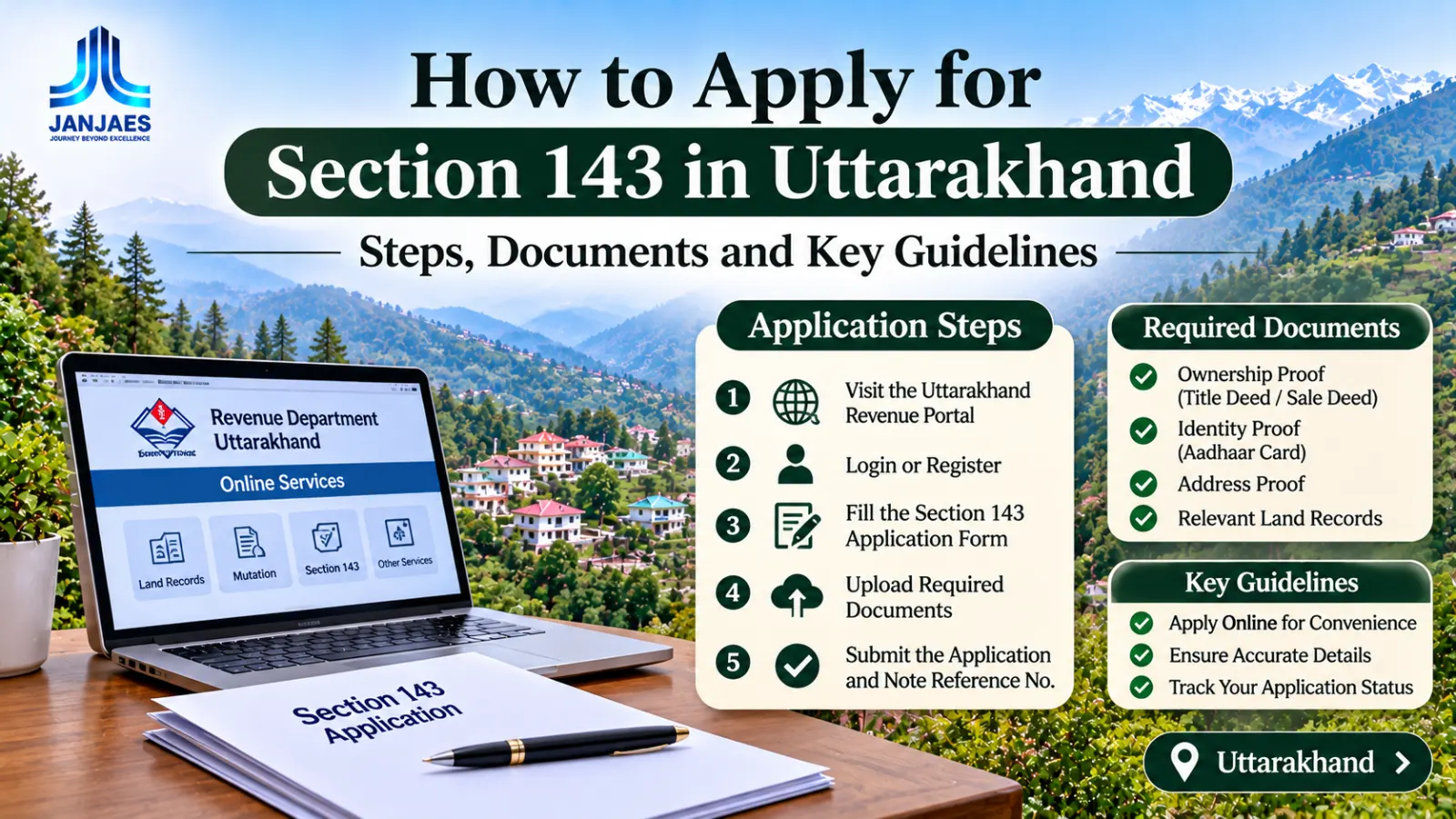
The state now runs this online through the Land Use Change Management System, the landuse uk gov in portal (landuse.uk.gov.in), managed by the Board of Revenue. The steps run like this:
- Open the portal and read the requirement list for your district.
- Enter the applicant details, then the land details, including the Khasra number.
- Upload the documents in the formats the portal asks for.
- Submit the application and save the acknowledgement for tracking.
- Respond to any objection or query the authority raises.
- Track the status, and download the final order once it is passed.
Behind the screen, the SDM routes your file through the Tehsildar and a Revenue Inspector, who visits the site and reports back. After an objection window, the SDM or SDO passes the order. The portal lists 15 days as the target, though field checks and objections can stretch it.
Documents you need, going by the official portal checklist:
- Applicant ID and address proof, with a photograph
- Khatauni and Khasra of the plot
- A photograph of the land and the Najri Naksha (site sketch)
- The declaration form, plus any title papers or co-owner consent the office asks for
143 Land Conversion Charges in Uttarakhand
This part is difficult to answer because there is no single flat fee.
The 143 land conversion charges in Uttarakhand are set by the revenue authority and depend on the plot's area, its location, and its value on the circle rate, so the amount differs from one district to the next.
There is also a portal application fee. So do not plan on a fixed figure. Confirm the current charge for your plot with the SDM office before you apply, since this is one cost buyers routinely forget to plan for.
Why Section 143 Matters?
The permission under Section 143 is what turns a field into a legal building plot, and that changes everything about the deal. Three reasons make it non-negotiable:
- Clean title and resale. A converted plot sells faster and at a better price, because the next buyer sees non-agricultural land on the record.
- Home loans. Banks lend against non-agricultural residential land, not against a farm plot you plan to build on.
- Legal construction. Building on unconverted farm land risks penalties and demolition, and it can block your completion and occupancy approvals.
So the conversion is not paperwork for its own sake. It is the line between a secure asset and a risky one.
Crucial Restrictions Under Section 154 and Land Laws
Before you even reach Section 143, Section 154 of the same Act decides whether you can buy the farm land in the first place. This is the clause that limits the purchase of agricultural land, and the 2025 Uttarakhand land law tightened it further. A buyer from outside the state cannot freely buy farm land, and normally needs government permission to acquire agricultural land beyond the allowed limit.
So the order of events matters. First confirm you are eligible to hold the land under Section 154 and the current rules, which our Uttarakhand land laws guide sets out. Where permission is required, our guide to land purchase permission in Uttarakhand covers that route. Only then does the Section 143 conversion make sense. For the specific limits on outside buyers, see our note on whether outsiders can buy a villa in Uttarakhand.
Frequently asked questions
What is 143 in property in Uttarakhand?+
Section 143 is the revenue law process that converts agricultural land into non-agricultural land in the record. Once the order passes, the plot is legally cleared for a home, shop or other non-farm use, and the agricultural-land rules no longer apply to it.
How to do 143 of land?+
Apply online on the landuse.uk.gov.in portal with the applicant and land details, upload the Khatauni, Khasra, site sketch and ID, and submit. The SDM routes it through the Tehsildar and a site inspection, then passes the order after an objection window.
How to check 143 land Uttarakhand online?+
Pull the plot's record on the Bhulekh Uttarakhand portal and read the land type. If the conversion is done, the record shows the plot as non-agricultural. You can also track a pending case and the final order on the landuse.uk.gov.in portal.