Can Outsiders Buy a Villa in Uttarakhand? Rules & Limits

On this page+
Someone from outside Uttarakhand can legally buy a villa in the state. What changes is what you can buy, how much, and where. Those three variables decide whether a purchase goes through smoothly or stalls at the sub-registrar's office.
This guide keeps to that question. Not the full history of the land law, just the practical rules that decide whether the property in front of you is buyable.
One caveat throughout. Rules shift depending on land classification, district, and whether the property sits inside a municipal or cantonment boundary. Nothing here replaces a property lawyer reading your specific papers.
A Built Villa Is Not the Same as Vacant Land
This is the distinction most buyers miss, and it changes everything downstream.
- Buying a built villa on residential land is the simplest route available to a non-resident. The land is already classified residential, construction approvals already exist, and you are stepping into a completed chain rather than starting one.
- Buying vacant land to build on opens two extra questions. Is the plot classified residential or agricultural? And if agricultural, has it been converted?
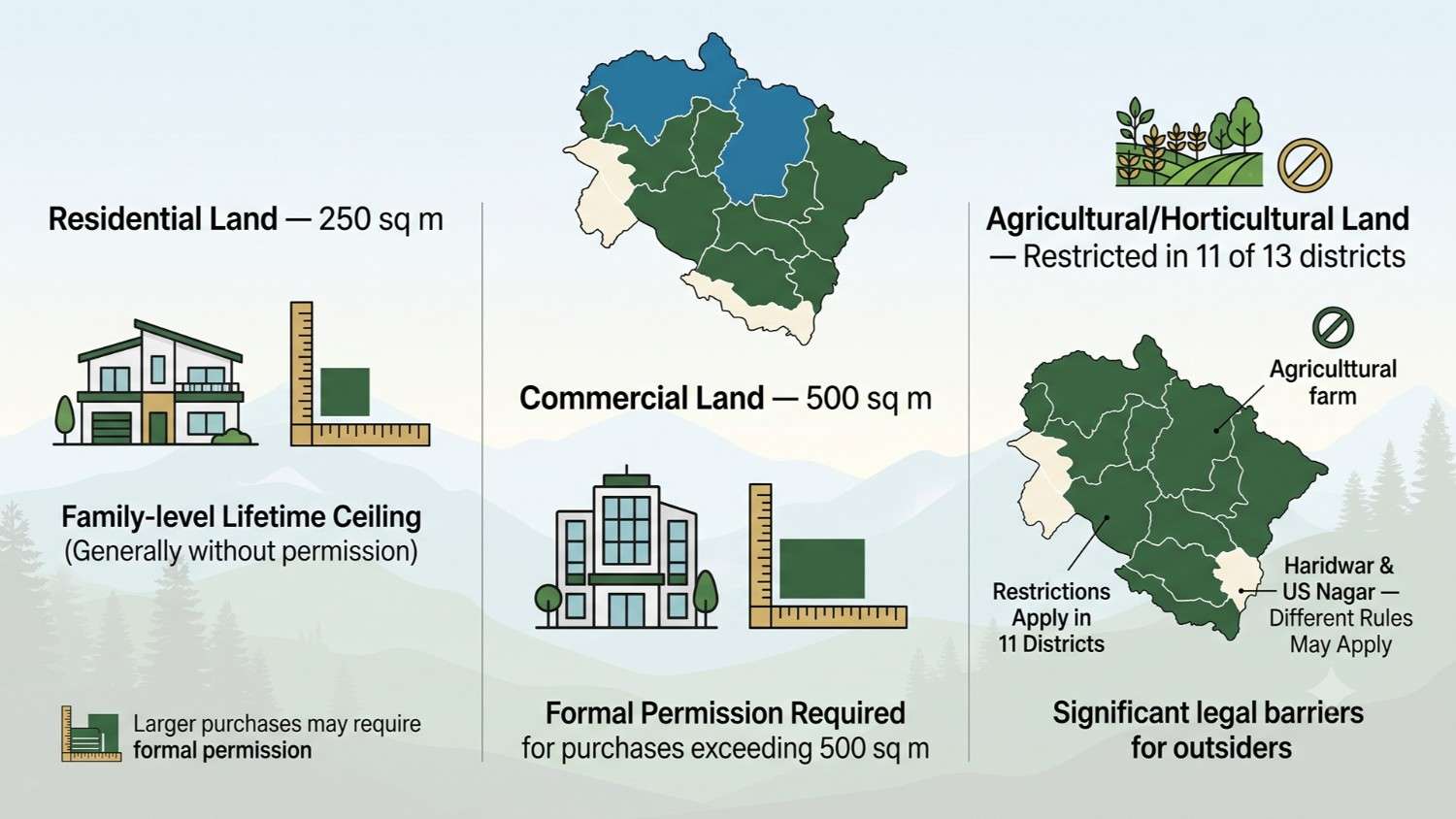
Agricultural land is where outside buyers get stuck. Non-residents cannot purchase agricultural or horticultural land in eleven of Uttarakhand's thirteen districts. Only Haridwar and Udham Singh Nagar sit outside that restriction.
And buying agricultural land as a non-agriculturist is not a technicality you fix later. The transaction is voidable, which means the state can cancel your title after you have paid. A registered sale deed does not protect you if the underlying classification was wrong.
How Much You Can Actually Buy
Three ceilings apply, and they get confused with each other constantly.
| Land Type | Permitted Area / Rule |
|---|---|
| Residential Land | 250 sq m (approx. 2,690 sq ft or 300 gaj), once in a lifetime per family |
| Commercial Land | 500 sq m |
| Agricultural Land | Barred for non-residents across the 11 restricted districts |
The residential allowance applies to the family unit, not the individual. The statute defines family precisely: husband, wife, minor children, unmarried sons, unmarried daughters and dependent parents. You cannot split a purchase across those members to stretch the limit, and an affidavit confirming this is now mandatory.
Worth reading the ceiling correctly, though. It is not a hard stop. It is the threshold below which you need no permission at all. Above it, a formal sanction route exists, which our guide to land purchase permission under Section 154 covers in detail.
Where the Extra Restrictions Bite
Location matters more here than in most Indian states.
Dehradun. Residential purchases within the municipal area work normally, subject to the 250 sq m ceiling. Agricultural land in the district is closed to outsiders.
Rishikesh. Straddles Dehradun and Tehri Garhwal, both restricted districts. Residential property is buyable. Agricultural parcels marketed as farmhouse land are not, however, they are described in the listing. Our guide to luxury villas in Rishikesh covers that market in more depth.
Landour. A genuinely different case. Landour is a cantonment administered under the Ministry of Defence, so state land law is only half the picture. Cantonment property splits into leasehold plots, which are government land held on long leases and need Defence Estates approval for any transfer, and freehold civilian plots, which are privately owned but still governed by Cantonment Board building and use rules. Both categories exist in Landour, and the difference materially changes what you are buying. Check which one applies before anything else.
Eco-sensitive and forest-adjacent zones. Areas around national parks and reserve forests carry construction clearances that sit on top of everything above.
The Legal Process, Briefly
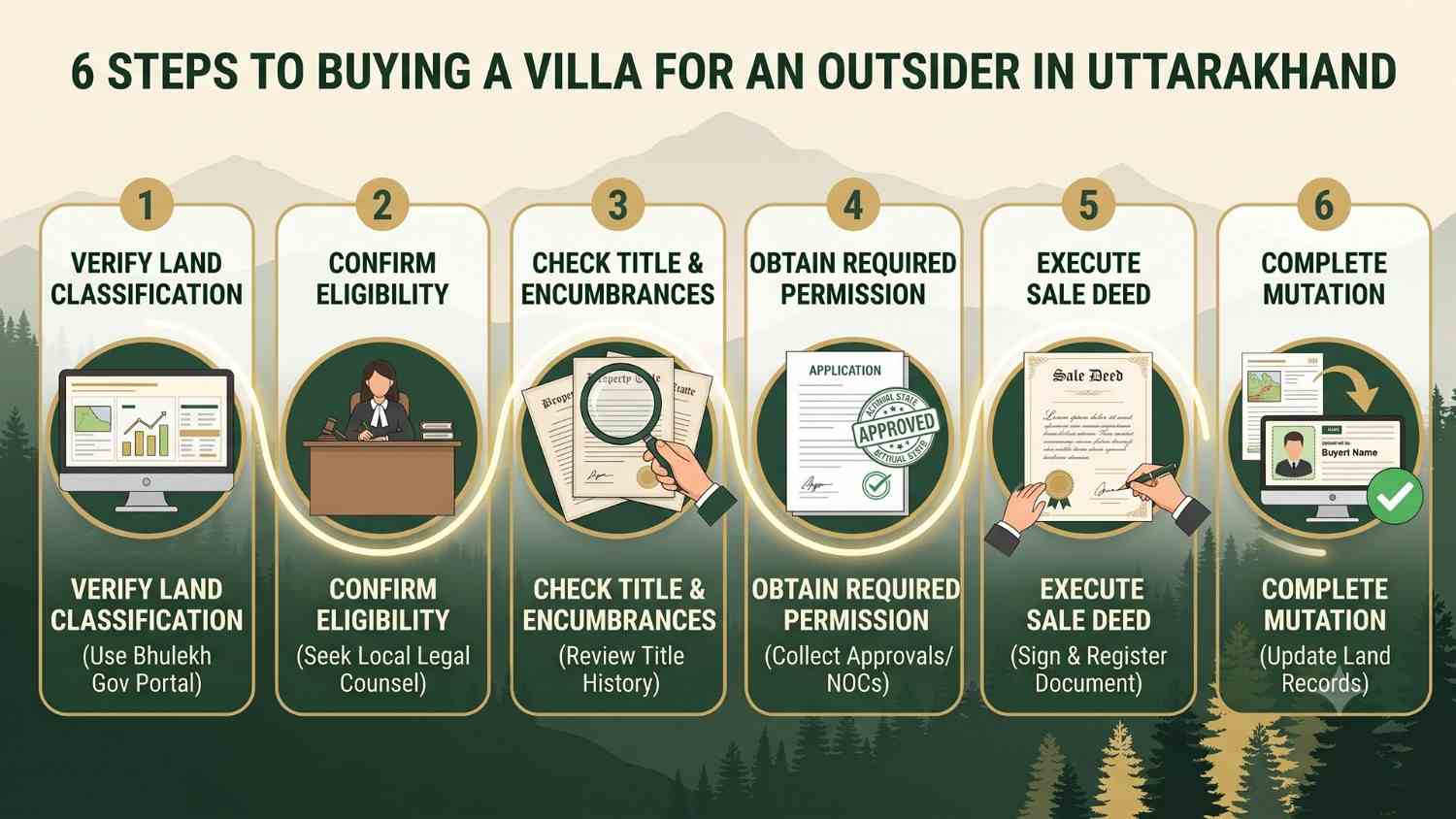
Six steps, in order.
| Step | Action |
|---|---|
| 1 | Verify land classification on the Bhulekh portal at bhulekh.uk.gov.in. |
| 2 | Confirm your buying rights in writing with a local property lawyer. |
| 3 | Check title and encumbrances, tracing the ownership chain back at least 30 years. |
| 4 | Apply for permission if the purchase exceeds the ceiling or falls outside residential use. |
| 5 | Execute and register the sale deed at the sub-registrar's office. Stamp duty is 5% for male buyers and 3.75% for female buyers, with a 2% registration fee. |
| 6 | Complete mutation so the revenue record carries your name. |
Skipping step one is the single most common and most expensive mistake in this market.
Why Choose Janjaes Infra for Your Uttarakhand Property?
Most of the friction above disappears when the classification work has already been done.
Janjaes Infra develops villa projects in Uttarakhand's Corbett belt, where the Privemont projects sit on land already classified residential, with individual units structured to fit inside the 250 square metre ceiling that applies to non-resident buyers. That means no conversion application, no sanction process, and a compliance question that reduces to verifying registration and filing your affidavit.
The team also supports buyers through documentation and registration, which matters when you are transacting from Delhi, Dubai or anywhere else outside the state. For Uttarakhand owners who cannot manage a property remotely, a leaseback arrangement is available on request, where you own the villa and the operations stay with us.
You can browse current Uttarakhand projects, or speak to the team throughourcontact page if you want a specific plot reviewed before you commit.
Send us your requirement and our team will get back the same day.
Enquire now