
Why Location Matters More Than Property Size
On this page+
In September 2022, people living in Rainbow Drive Layout in Sarjapur, Bengaluru, traveled to their jobs using small, round boats called coracles. They crossed through their own gated community to get to work.
These were not small homes. Rainbow Drive is a premium villa layout. In Yemalur, the founder of a technology firm paid ₹42,000 for a single hotel night because her house was underwater. Across the Outer Ring Road belt, apartments sat without power or water while people walked seven kilometres and hitched rides on tractors.
Now the part that matters if you are buying anything. A year later, Deccan Herald reported that property prices in the flood-hit areas had plummeted. In one Nallurahalli complex, ten of ninety-six units were vacant. Five families had rented out and left. Five had sold and gone.
Not one of them was saved by square footage.
That is the argument in a single case, and it is why location matters more than property size in a way most buyers accept in principle and ignore in practice. But "location, location, location" is a slogan, not a method. So let us get to what actually prices inside a location, and what does not.
The Slogan is True and Useless
Lord Harold Samuel, the British property magnate who is credited with the phrase, was not offering a checklist. He was describing where value comes from. Nobody has ever translated it into something you can verify on a Saturday afternoon.
Here is the translation. The market does not price _"Gurgaon" or "Whitefield" or "Ramnagar."_It prices a specific set of attributes attached to a specific plot, and those attributes are measurable:
- Actual travel time to the nearest employment or tourism node, measured at peak hour rather than at 3 am
- Elevation and drainage relative to the immediate surroundings
- Whether committed infrastructure is funded and under construction, as opposed to announced
- Depth and quality of the local buyer pool at your specific configuration
- Legal certainty of the land itself, meaning classification and title
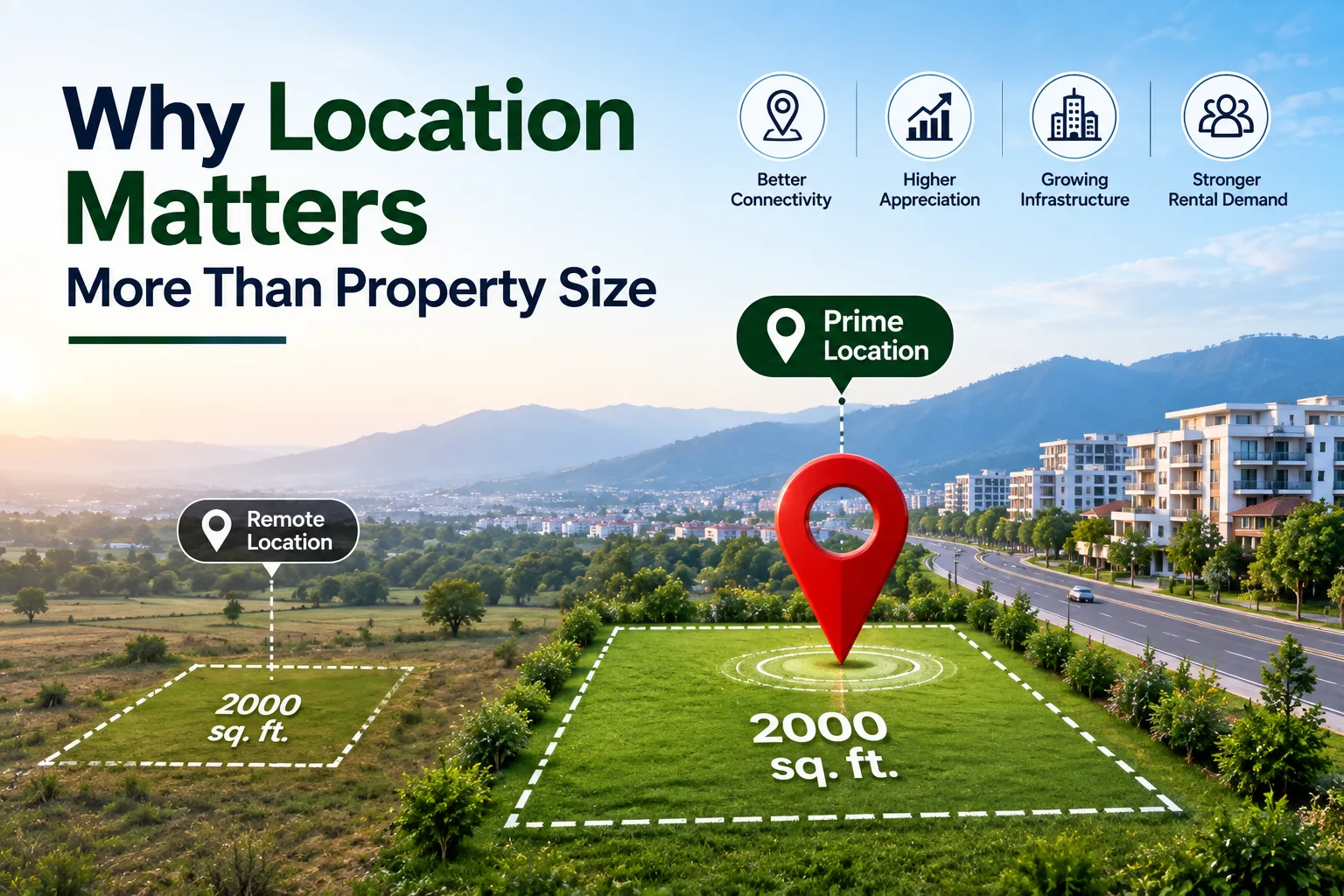
Two plots 800 metres apart can differ sharply on every one of those. That gap is what people are actually referring to when they say location. Size is a single number. Location is five or six variables, and it is where the return lives.
What the National Data Actually Says
The RBI's All-India House Price Index rose 4.2 percent year on year in the January to March 2026 quarter. A modest, healthy-sounding number.
Except Knight Frank found that during comparable periods, NCR, Bengaluru, Hyderabad and Chennai recorded double-digit appreciation in quality supply segments, while markets carrying older or stalled inventory stayed roughly flat.
Sit with that for a second. The national average is the midpoint between double-digit growth and near-zero. Same country, same quarter, same interest rate environment. The variable separating those two outcomes is not size. It is where the stock sits and what condition it is in.
That is the entire thesis, and it comes from the central bank's own registered-transaction data rather than from anybody's brochure.
Size Is the Half That Depreciates
Choose your neighbour before the house, goes an old Arabic proverb, and the arithmetic backs it more literally than the people who repeat it probably realise.
When you buy a villa you are buying two assets bundled together. Land, and a structure sitting on it. The land appreciates according to its location. The structure depreciates with age and requires maintenance to hold its value at all.
So the honest equation reads:
Villa value = land appreciation + rental income − structural depreciation − upkeep
Every additional square foot of built area you pay for is a purchase of more of the depreciating component. It does not buy you more location. A 6,000 square foot villa in a weak micro-market owns the same land value per square yard as a 3,000 square foot villa next door, and carries twice the maintenance liability.
This is not an argument against buying large. It is an argument against buying large instead of buying well, which is the trade most people make when a budget forces the choice. Our breakdown of land Vs villa returns works through that split in more detail.
Location Gets Repriced. Size Never Does.
Here is the asymmetry that decides long-run outcomes.
The Delhi–Dehradun Expressway opened in April 2026. Six lanes, roughly 210 kilometres, and it cut the Delhi to Dehradun drive from about six hours to two and a half. Analysts projected 15 to 25 percent appreciation across corridor micro-markets within eighteen to twenty-four months. Uttarakhand had already revised circle rates upward by as much as 22 percent across Dehradun district in October 2025, before the road even opened.
Every plot in that corridor was repriced by an event entirely outside itself.
Nothing comparable happens to square footage. No infrastructure announcement makes your extra bedroom worth more. No policy change reprices your plot ratio. Size is a fixed input, purchased once at full price. Location is an option on everything that happens around it for the next twenty years.
Which is also why the reverse risk is real, and worth taking seriously.
Location is Not Permanent Either
Back to Bengaluru, because the detail most coverage skipped is the one that should change how you evaluate a "premium" address.
After the 2022 floods, the BBMP published a list of stormwater drain encroachers. It included marquee tech parks and, specifically, plush gated communities. Bagmane Tech Park, Purva Paradise, Eco-Space in Bellandur, Wipro in Doddakannelli, Gopalan in multiple locations.
Read that carefully. The developments that flooded were, in part, flooded because of how developments in that belt had been built. Buyers had paid a premium for planned, gated, professionally developed communities, and the planning itself had contributed to the drainage failure.
The city recorded 709 mm of monsoon rain that season, the second highest since 1971. But as one Bengaluru investor pointed out at the time, Mumbai and Singapore receive around 2.5 times the rainfall Bengaluru does without going under. The problem was not weather. It was what had been built on the water's path.
So a location can be downgraded. By drainage, by unplanned density, by infrastructure that never arrives, by an approvals scandal. When it is, the properties in it fall together regardless of how many bedrooms each one has. If you want the wider version of this argument, our piece on mistakes to avoid when investing in real estate covers the verification failures that produce exactly this outcome.
The Exit Is Where Size Punishes You
One more thing that rarely gets said plainly.
Oversized property in an average location has the smallest buyer pool in the market. A six-bedroom villa in a corridor where demand concentrates around three and four bedrooms is not a premium asset. It is a narrow one, and narrow assets sit.
Location works the opposite way. A modestly sized home in a corridor with real demand has a wide pool of both end-users and investors competing for it, which is what actually produces a clean exit at a fair price.
Appreciation is what you read about. Liquidity is what you experience.
What to Actually Measure Before You Buy
The operational version of all of the above:
| No. | Check | What to Do |
|---|---|---|
| 1 | Drive the Route | Drive the route at peak hour in a normal car and time the journey yourself. |
| 2 | Visit During Monsoon | Observe where water collects and how quickly it drains after rainfall. |
| 3 | Check Elevation & Drainage | Check the property's elevation relative to surrounding land and identify the nearest lake, drain or watercourse. |
| 4 | Verify Infrastructure | Confirm that planned infrastructure is funded and under construction. A tender number is stronger evidence than a press release. |
| 5 | Check Comparable Listings | Count comparable properties in the same pocket and configuration, and check how long they have been listed. |
| 6 | Verify Land Records | Pull the land record yourself and check the official land classification instead of relying on the seller's description. |
Six checks. A weekend. They will tell you more about your return than any floor plan.
For buyers looking at markets where these variables are currently moving, Janjaes Infra operates in Uttarakhand, where the expressway is repricing the corridor, across Jaipur, and in Delhi NCR with Vista Lux. Our complete buyer's guide to villas in Jim Corbett works through micro-location pocket by pocket, which is the level at which these decisions are actually made.
Frequently asked questions
Why does location matter more than property size in India?+
Because location determines both halves of your return and size determines only one. Land appreciates with its location while the built structure depreciates with age. RBI data shows national house prices rose 4.2 percent year on year in early 2026, but Knight Frank found quality supply in NCR, Bengaluru, Hyderabad and Chennai delivering double-digit growth while weaker inventory stayed flat. That gap is location, not square footage. Location also gets repriced by external events such as new infrastructure, while size never does.
How much can micro-location affect property value?+
Considerably, and often within short distances. Two plots under a kilometre apart can differ on peak-hour access, elevation and drainage, land classification and local buyer depth. Bengaluru's 2022 floods illustrated the extreme case: premium villa layouts in low-lying pockets saw prices fall and units go vacant, while properties on higher ground in the same city were unaffected.
Is a smaller home in a prime location better than a larger one in the suburbs?+
For investment purposes, usually yes, provided the prime location has genuine demand rather than only prestige. The smaller home holds a wider buyer pool at exit and its land component appreciates faster. The larger suburban property carries higher maintenance on a depreciating structure and a narrower resale market. The exception is where you are buying primarily for personal use and the space itself is the point.
What location factors actually increase property value?+
Committed and funded infrastructure rather than announced projects, genuine peak-hour access to employment or tourism nodes, favourable elevation and drainage, established social infrastructure such as schools and hospitals, clean land classification with no title ambiguity, and constrained future supply. Marketing distance figures and proposed projects should be discounted heavily until construction is visible.
Does a bigger villa always sell for more?+
In absolute terms usually, but not per square foot, and not faster. Oversized properties in average locations have the narrowest buyer pool and the longest time to sell. A configuration matched to local demand in a strong location typically achieves a better price per square foot and a considerably cleaner exit than an outsized home in a weaker one.
Send us your requirement and our team will get back the same day.
Enquire now