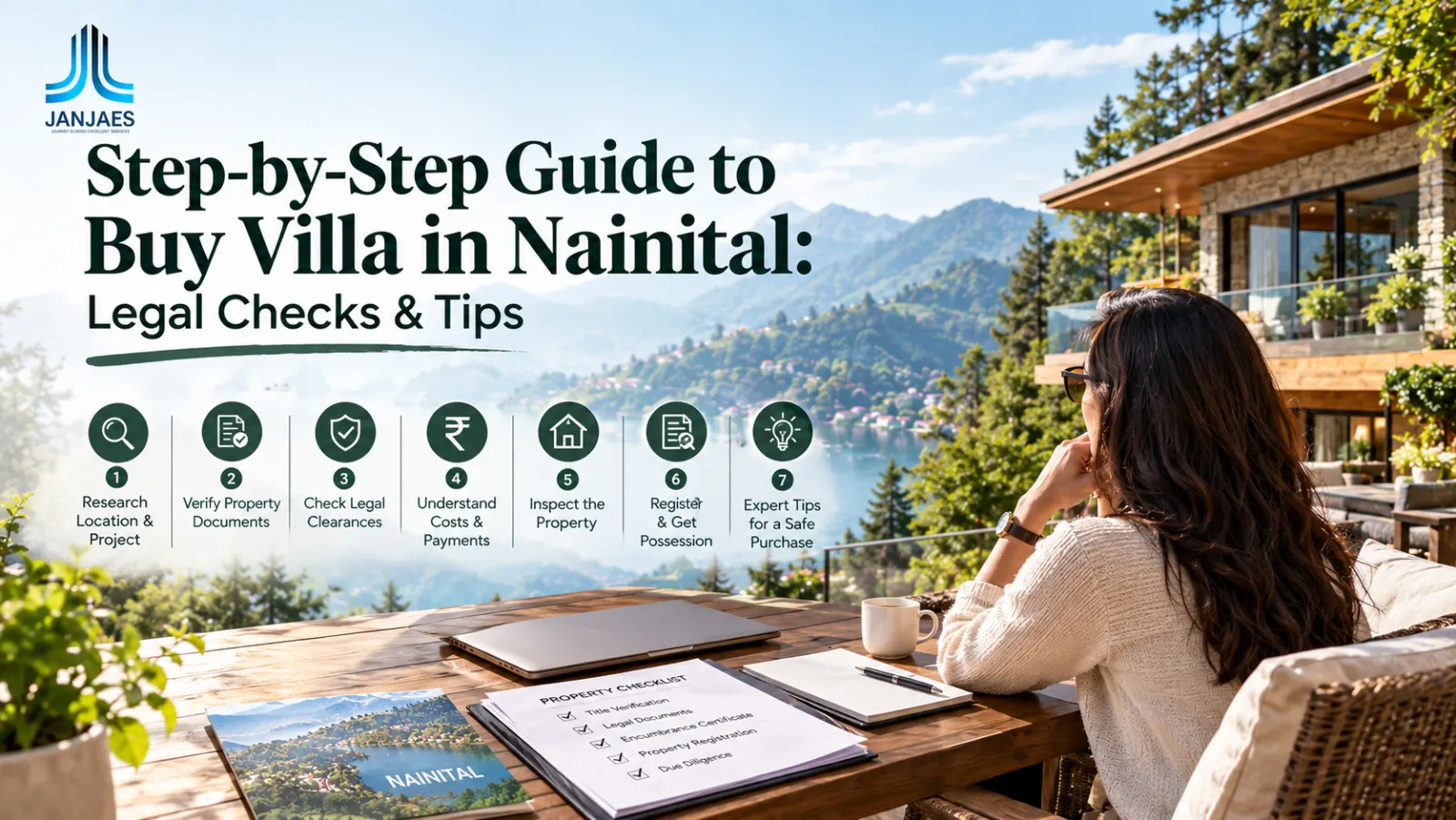
Step-by-Step Guide to Buy Villa in Nainital: Legal Checks & Tips
On this page+
- Step 1: What Do You Want This Home to Do for You?
- Step 2: Does the Law Allow You to Buy at That Spot?
- Step 3: Should You Pick a Project Villa or an Independent House in Nainital?
- Where Does Janjaes Infra Fit Into These Steps?
- Step 5: Is the Building Itself Approved?
- Step 6: What Should You Check During the Inspection?
- Step 7: What Will the Purchase Cost Beyond the Price?
- Step 8: How Do You Close the Deal and Register It?
- Which Step Should You Never Rush When You Buy a Villa in Nainital?
Planning to buy a villa in Nainital? The whole process comes down to eight steps:
- Define your purpose.
- Confirm the law allows the purchase.
- Choose the type of home.
- Check the title.
- Check the approvals.
- Inspect the house.
- Total the costs.
- Register the sale.
Each step hides a check or two that sellers rarely mention. Below, we take them in order, drawing on the 2025 state land law, current listing data and home-buying advice from Tata Steel Aashiyana.
This guide is for information only. Please confirm your own case with a property lawyer.
Step 1: What Do You Want This Home to Do for You?
Start with the reason, since it shapes every later choice. A weekend retreat, a retirement home and a holiday rental each point you towards a separate part of the district.
Want schools close by? Stay in town. Calm seekers lean towards Bhimtal or Ramgarh, and rental-minded buyers look downhill at Ramnagar.
Once the purpose is clear, set the budget. Listings on Square Yards put a luxury villa in Nainital for sale between roughly ₹2 crore and ₹4.05 crore.
If you plan to borrow, Tata Steel Aashiyana notes that a down payment runs from 10 to 20% of the property's value, and that a credit score of 750 improves your odds of approval. It also advises keeping "a buffer for unexpected expenses, like repairs or furnishing." In the hills, we'd make that buffer generous.
With the purpose and money settled, the next question is a legal one.
Step 2: Does the Law Allow You to Buy at That Spot?
Plenty of deals collapse right here. Uttarakhand's land law, as amended by Act No. 11 of 2025, treats you as an outsider if your family owned no property in the state on or before 12 September 2003.
Where the house stands changes your position:
- Inside the town, a Nagar Palika area, the outsider limits don't apply.
- Outside town limits, an outsider family may buy one residential plot of up to 250 sq m in a lifetime, backed by an affidavit.
- Farmland across the district is closed to outsiders.
So if a seller pitches an orchard "farmhouse villa" and you fail the 2003 test, our advice is to walk away. NRIs face an extra bar, since RBI rules keep farmhouses off their list. Our dedicated NRI investment solution and Uttarakhand land laws guide go deeper.
After you know the law is on your side, you can decide what kind of home to chase.
Step 3: Should You Pick a Project Villa or an Independent House in Nainital?
Both routes work, but they carry unequal risk. A standalone home gives you more land and privacy, and it also leaves every check in your hands.
A registered project shifts part of that burden to the developer. Under Section 3 of the RERA Act, 2016, projects on more than 500 sq m of land, or with more than eight units, must register before selling, so search the project's name on Uttarakhand's RERA portal.
Timing matters as well. Tata Steel Aashiyana points out that ready homes give faster possession at a higher price, while under-construction homes cost less but can run late.
In our view, a project home suits owners based in another city, while a standalone house suits someone moving up full-time.
Where Does Janjaes Infra Fit Into These Steps?
If a project sounds right, look a couple of hours downhill from the lake. Ramnagar, where the road to Jim Corbett begins, falls within the same district, and that's where Janjaes Infra has chosen to build.
Each home stands on residential land, is sized to the 2025 limits and has its records checked before sale. That means steps 2 to 4 are largely done before you arrive. Still, verify our papers as you would anyone else's. You can start with Privemont 2.
Whichever home you shortlist, the paperwork comes next.
Step 4: How Do You Confirm the Seller Owns It?
Tata Steel Aashiyana puts the rule simply: the seller "should have full rights over the property he claims to own." Your job is to prove it on paper.
Ask for these records and match every name and plot number:
- The latest khatauni from Bhulekh Uttarakhand, showing the current owner.
- Every past sale deed in the chain of ownership.
- The mutation entry recording the seller as owner.
- A bank no-objection letter if the property carries a loan.
Our property document checklist goes paper by paper. Still, a clear title speaks for the land alone; the building needs its own proof.
Step 5: Is the Building Itself Approved?
In hill towns, approvals come from the local municipality or development authority. Ask for the sanctioned building map and, for a finished home, the completion certificate.
Then walk through the house with the map in hand. Any extra floor or covered terrace missing from the map points to unapproved work, which can draw notices years later.
Once the papers line up, it's time to look at the house with a critical eye.
Step 6: What Should You Check During the Inspection?
An old carpenter's saying fits this step well: measure twice, cut once. A second visit costs less than a repair bill.
Tata Steel Aashiyana suggests checking plumbing, structural damage and ventilation, along with flood risk for land. In the hills, add the slope, the retaining walls, damp patches after rain and how much winter sun the main rooms get. An afternoon with a structural engineer is money well spent.
For a fuller list of on-site checks, read our guide to [“picking the right hill home” - Internal Link to How to Choose the Best Villa in Nainital? (7 Things to Tick)]. Once the house passes, turn to the bill.
Step 7: What Will the Purchase Cost Beyond the Price?
The listed price is only the largest number on your bill. Taxes and fees push it up by lakhs.
| Cost | Rate |
|---|---|
| Stamp duty | 5% for male buyers, charged on the circle rate if it beats the agreed price (HomeFirst India) |
| Registration fee | 2%, capped at ₹25,000 |
| TDS | 1% of the price when it is ₹50 lakh or more, deducted by you and paid to the government (TDSMAN) |
| Professional fees | Lawyer, structural engineer, valuer |
Buying a villa for sale in Nainital at ₹3.5 crore? Expect about ₹17.5 lakh in stamp duty. You'd also withhold ₹3.5 lakh as TDS from the seller's payment and deposit it under your PAN.
With the money mapped, the final step is the signing.
Step 8: How Do You Close the Deal and Register It?
Every attempt to buy a villa in Nainital ends at the sub-registrar's desk, but an agreement to sell comes before that. Make sure it states the payment schedule, the handover date, penalties for delay and the terms for cancelling.
Pay through bank transfers only, never in cash. On registration day, you, the seller and two witnesses appear before the sub-registrar with identity proofs. Ownership passes only through this registered sale deed, so treat any power-of-attorney shortcut as a red flag.
Afterwards, apply at the tehsil to record the mutation in your name. Until that entry changes, the revenue records still show the old owner.
Which Step Should You Never Rush When You Buy a Villa in Nainital?
Step 4, in our opinion. A damp wall can be repaired and a budget can stretch, but a broken chain of ownership can't be fixed once the sale is registered. Give it any extra week you have.
Anyone hoping to buy a Nainital property can clear these eight steps within weeks when the papers are in order. Want a second pair of eyes on a listing? Send it to Janjaes Infra.
Frequently asked questions
Can an outsider buy a villa in Nainital?+
Yes. Within town limits, the outsider caps don't apply. Beyond them, an outsider family can buy one residential plot of up to 250 sq m, with an affidavit.
Which documents prove a villa for sale in Nainital has a clear title?+
The current khatauni, every past sale deed, the mutation entry and, if the property was mortgaged, a bank no-objection letter.
How much stamp duty do I pay when I buy a villa in Nainital?+
Men pay 5%, worked out on the circle rate when it exceeds the agreed price. The registration fee is 2%, capped at ₹25,000.
Do I need to deduct TDS on a hill property?+
Yes, if the price is ₹50 lakh or more. You deduct 1% from the seller's payment and deposit it with the tax department.
Is an independent house in Nainital riskier than a project villa?+
It needs more checks from you, since no developer or RERA registration covers title and approvals. Absentee owners tend to find a registered project easier.